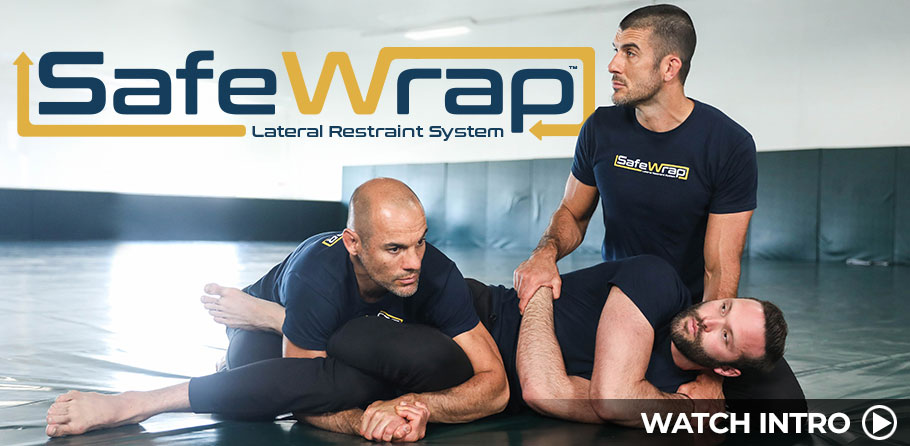
SafeWrap™ is a proprietary system of lateral restraint by which two people can effectively and safely subdue an aggressive, suicidal, or emotionally disturbed person for an extended period of time while greatly reducing the risks of injury to all parties involved.
The system is effective enough for law enforcement use and safe enough for healthcare applications, as it utilizes zero joint locks or choke holds; the system is also designed to avoid compression on the diaphragm, facilitating breathing and greatly reducing the potential of a panicked response by the person being restrained.
All the techniques in the SafeWrap System are based on the principles of Brazilian Jiu-Jitsu (BJJ) as developed by the Gracie Family over three generations.
The SafeWrap System was originally designed for healthcare and law enforcement professionals, but it was so effective that it quickly became clear that it had the potential to save lives in every sector:
- Law Enforcement: Officers can rely on the system to safely subdue individuals and de-escalate the situation before transitioning into the system's lateral handcuffing procedures without ever relying on prone controls.
- Corrections: For inmates who need to be restrained, corrections officers can use the system to accomplish the task quickly and safely.
- Military: When military members are interacting with civilians, foreign or domestic, the system can be used to take effective control with the lowest level of necessary force.
- First Responders: Firefighters, EMTs, and paramedics can use the system to safely control a person until law enforcement arrives.
- Healthcare: Medical professionals can greatly reduce the risk of injury to all parties when using the system to safely restrain patients before transitioning into the system's four-point restraint procedure.
- Flight Attendants: When faced with an unruly or assaultive passenger at high altitude, flight attendants can use the system to safely restrain the person on the floor or in their seat.
- Elderly Care: Considering the aging bodies and various states of dementia and frailty in this population, caregivers can use the system to administer safe and compassionate care.
- Security: From arenas to casinos to retail stores, security guards can use the system to safely control civilians before applying handcuffs or passing them off to law enforcement.
- Education: With youth violence on the rise, educators can use the system to safely restrain students while also protecting themselves from harm.
- Childcare: The system can be adapted for safe use on children of any age in the event that they become a threat to their own safety, or that of others, and need to be de-escalated.
...and the list goes on.
Any institution that requires its staff members to interact with the public would benefit from certifying its staff in the SafeWrap System, and once all staff members are SafeWrap certified, any two team members are empowered to handle a crisis with confidence, clear communication, composure, and care.
We've tested the SafeWrap System on countless people of all ages, shapes and sizes, from civilians to police officers, from white belts to black belts, from young children to 300lb fully resistant men. Not a single person escaped, and not a single person got injured.
Before SafeWrap, the most common method of 2-on-1 subject restraint was prone restraint, because people always thought that you had to put someone on their stomach in order to get their hands behind their back for handcuffing. But this restraint method has several significant flaws that increase the risk of panic and injury to everyone involved.
Here are the top considerations when comparing the SafeWrap System to prone restraint:

Reduces AsphyxiaPositional asphyxia occurs when an individual's physical position prevents them from breathing adequately. Compression asphyxia occurs when external weight is applied to the torso of an individual, impairing breathing. When two or more people are using their body weight to control an individual in a supine or prone position, the risks of compression asphyxia is at its highest, since the individual cannot expand their lungs easily and naturally. Using the SafeWrap System, the individual is restrained on their side so that no external weight is placed on their thoracic region, thereby greatly reducing the risk of positional and compression asphyxia.
Reduces Weapon AccessOne of the greatest dangers of prone restraint is that the individual can reach for their waistband or pocket to retrieve a weapon, since their hands are hidden from visibility. When utilizing the lateral restraint position of the SafeWrap System, the users have clear visibility and full control of the individual's hands, thus eliminating their ability to access their own weapon, or someone else's, in the immediate area.
Reduces EscapeDuring restraint, any escape attempts may result in increased risk for the individual being restrained, the restrainers, and any third parties. The most common and intuitive escape behavior used by individuals subjected to prone restraint, is for them to try to "build the house," which consists of them pushing off the ground to post on their hands and knees with the final goal of returning to a standing position. Since the SafeWrap System provides the users full control of the individual's arms and legs in the lateral restraint position, the individual is incapable of pronating to "build the house," which helps keep everyone safe throughout the encounter.
Reduces PanicBeing forced into prone restraint, with the weight of two or more people on your body, will often induce severe panic in the individual being restrained. This results in the impaired function of the individual's pre-frontal cortex, making voluntary compliance much more challenging to achieve. Since the SafeWrap System restrains the individual in the familiar and humane lateral recovery position, the likelihood and severity of panic is greatly reduced, making voluntary compliance achievable in the least amount of time possible.
Reduces InjuryA significant concern with prone restraint is that it often requires three or more people to be effective in what is often characterized as a "dog pile" on the individual. This escalation of force, including the significant compression on the thoracic region, will often result in serious injuries or death to the individual being restrained. Since the SafeWrap System requires only two people to be deployed safely and effectively – and does not utilize joint locks, choke holds, or pain compliance techniques – it reduces the chance of injury to an absolute minimum. If anyone arrives on scene to help, beyond the two applying the system, they can then be utilized to secure the surrounding area, enhancing safety for all involved.
Reduces LitigationIn every use of force there is a risk of injury, but the escalation of force increases these risks. With increased risk of injury, the likelihood of excessive force litigation goes up exponentially. When utilizing the SafeWrap System, the effectiveness of the restraint is such that the escalation of force is kept to an absolute minimum. Not only does this reduce the risk of injury to everyone involved, but it also reduces the risk of excessive force litigation.
Facilitates CommunicationWhen prone restraint is used on an individual, it is often chaotic and unpredictable since the users are operating independently without a plan, and the random positioning of the users makes communication challenging. When all the members of an organization are SafeWrap certified, any two people can work as a team to deploy the system, and communication during the encounter is greatly enhanced by the fact that both users are positioned on one side of the individual so they can make eye contact and calmly speak to one another throughout the entire process.
Facilitates De-EscalationOne of the core requirements for successful de-escalation is effective communication with the individual being restrained. And since it has been well established that non-verbal communication is equally important (if not more) than verbal communication, facial expressions are of critical significance during this process. When the SafeWrap System is deployed, the users have full visibility of the individual's face which greatly facilitates verbal communication while also allowing the users to pick up on the non-verbal cues that are often out of sight and undetectable when the subject is face-down in prone restraint.
Facilitates InterventionLaw enforcement officers have a "duty to intervene" any time they observe excessive force being used by their colleagues, but this can be very difficult for untrained officers who, themselves, may be panicking. Once a team of two SafeWrap certified officers arrives on the scene of a use of force encounter, not only are they capable of restraining an individual with the lowest level of force, but if they observe untrained officers using excessive force, they can intervene confidently and effectively to keep all parties safe.
Facilitates HandcuffingOne of the few benefits of prone restraint is that it positions the individual with their arms under their body thereby reducing the ease with which they can launch an attack. One disadvantage of this position, however, is the fact that once the individual's hands are buried beneath their body, it is often very difficult to extract their hands for handcuff application. One of the unique benefits of the SafeWrap System is that it contains the first and only lateral handcuffing procedure, which allows safe handcuff application without utilizing prone restraint. For healthcare and corrections applications, the SafeWrap System also contains the safest and most secure method of applying four-point restraints, whether it be on a stretcher or in a restraint chair.
Facilitates AftercareOne of the most significant dangers associated with prone restraint is that once an individual loses consciousness due to compression asphyxia or any other stimulus or medical condition (known or unknown), the restrainers are often unaware of their condition since the individual is lying face-down. Regardless of the cause of the medical emergency, restrainers should continuously monitor the condition of the individual under restraint. The potential undetectability of serious medical events when an individual is in prone restraint is a significant factor in why so many deaths have resulted from its use. The SafeWrap System, on the other hand, restrains the individual on their side so that users are able to visually and tactilely monitor the condition of the individual, ensuring that immediate aid will be rendered in the event of a medical emergency.
Instructor CertificationTo learn and teach the SafeWrap System, one must complete the SafeWrap Instructor Certification Program (SW ICP). The SW ICP is open to individuals looking to learn the system for personal and family safety as well as institutional representatives looking to bring the system to other members of their organizations.
Once one or more staff members within an institution have completed the SW ICP, and the organization obtains a license to use the system, they can teach the system to all their staff members which can be done in as little as 2-4 hours of hands-on training per year.
In addition to learning the complete SafeWrap System, participants in the SW ICP will also learn time tested teaching methodologies that have been developed and refined by the Gracie Family over three generations.
Instructor certification can be accomplished in person at one of the two-day hands-on courses, or the entire course can be completed online from anywhere in the world using the Gracie University interactive online learning system and the corresponding video evaluation process.
For organizations that do not have a resident SafeWrap certified instructor on their staff, Gracie University can send one of its own instructors (applicable fees apply) to conduct the 2-to-4-hour hands-on training for the staff each year.
Bottom line, if you want to empower your staff with the SafeWrap System, for their safety and for the safety of everyone they interact with, we’ll work together to make it happen one way or another.
Upcoming Instructor Certification Course: October 7-8, 2024 at Gracie University HQ in Torrance, CA
SafeWrap LicensingThe SafeWrap System is patent-pending (application # 63/647,962), copyrighted and trademarked worldwide. Each person who successfully completes the SW ICP may obtain a license, free of charge, to personally use the SafeWrap System and teach it to their immediate family members, so that in a moment of crisis, the family can operate as a team, take control, and de-escalate the situation in the safest way possible.
In order for this system to be taught to or utilized by any or all members of an institution, however, the institution must first obtain a SafeWrap License and pay the appropriate licensing fee based on the number of system users within the organization. Any individual or institution found to be infringing on the intellectual property rights of Gracie Global, LLC, by using the SafeWrap System without a license, will be prosecuted to the full extent of the law.
Here are some of the primary benefits associated with SafeWrap licensing:
- License to SafeWrap: Licensed users are authorized to use the SafeWrap System in any situations requiring emergency restraint of an aggressive, suicidal or emotionally disturbed person.
- SafeWrap Online Access: Licensed users will receive password-protected access to the SafeWrap System online video course for the duration of the licensing period, so they can review the material 24/7 and get immediate video access to any and all improvements to the system.
- Expert Witness Support: If a licensed user gets involved in litigation surrounding the use of the SafeWrap System, Gracie University will provide expert witness support on their behalf.
Bottom line: what CPR is to emergency first aid, SafeWrap is to emergency restraint. It's VERY easy to learn and it can mean the difference between life and death. So, as they say, it's better to know it and not need it, than to need it and not know it.
For more information on obtaining a free SafeWrap license for personal and family use, or a paid SafeWrap license for institutional use, please submit the licensing inquiry below.
Frequently Asked Questions
Yes, you can patent a method or process in the United States and other countries. In the US, methods and processes are considered a type of intellectual property (IP) that can be protected by utility patents.
To be eligible for patent protection, a method or process must meet certain requirements, such as:
- Novelty: The method or process must be new and not obvious to others in the same field.
- Non-obviousness: The method or process must be significantly different from existing methods or processes.
- Utility: The method or process must have a practical application or provide a benefit.
- Enablement: The patent application must fully describe how to make and use the invention.
Some other examples of methods or processes that can and have been patented include:
- Business methods, such as a new way of processing transactions or managing data
- Software processes, such as a new algorithm or data analysis technique
- Manufacturing processes, such as a new way of producing a material or assembling a product
- Medical methods, such as a new surgical technique or drug delivery system
The SafeWrap System meets all the requirements for patentability, and Gracie Global, LLC (DBA Gracie University) intends to protect its intellectual property to the full extent permitted by law.
Any person who successfully completes the SafeWrap Instructor Certification Program (SW ICP) may obtain a license to use the SafeWrap System, for personal and family safety, free of charge for the duration of their certification period. However, for the SafeWrap System to be taught to or used by other members within an institution, the institution must first obtain a SafeWrap License and pay the appropriate licensing fee based on the number of system users within the organization. Licensing fees will be calculated once an inquiry is submitted by a representative from the institution. The licensing inquiry may be submitted before or after an instructor has completed the SW ICP.
In the event that an institution is committed to implementing the SafeWrap System, but does not have the financial means to do so, Gracie University would consider an alternate partnership model wherein the institution would be granted a license to use the SafeWrap System at a discounted rate (or no cost at all) in exchange for providing data on system's use and helping Gracie University spread the word about the system's effectiveness.